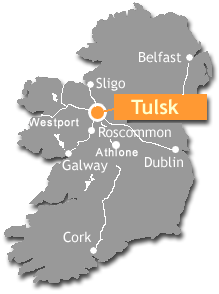
The Discovery Programme’s fourth Open Day at the site of its primary archaeological excavations in Tulsk, Co. Roscommon, will be held on Thursday 24th July from 2pm to 5pm.
Cruachan Aí Heritage Centre is delighted to host Ireland’s archaeological research institute’s annual event, and help with the organization of free guided tours and access to the centre and the excavation site at Tulsk Fort.
The Discovery Programme’s work, funded by the Heritage Council, has been examining the nature of Gaelic Lordship and settlement; focussing since 2003 on the history and development of Tulsk, as a principal residence of the O’Conor Rua lords.
Their 2008 season has exposed a series of critical strata that now more fully than ever explain the dating and development of the site. This year’s work has uncovered the ring fort that underlies the medieval tower. This summer’s work has also shown that the tower was built in 3 main phases, with the earliest phase being a stout blocky squared building whose walls were 9ft thick.
On Thursday 24th, the team will be leading guided tours to the public around the excavated features, which will begin from the Cruachan Aí Centre every 45 minutes. There will also be displays of the artefacts and environmental remains which have been found.
Families, groups, and individual visitors are all very welcome. This is a free event. There will be quizzes and games for kids, and a wine reception afterwards. Please be sure to bring appropriate weather gear, in case we have a little rain on the day.
Wednesday, July 23, 2008


Wednesday, July 2, 2008
Learning Irish The Easy Way
Are you interested in learning the basics of spoken Irish?
If so call along to the Cruachan Ai Heritage Centre on Wednesdays between 1pm and 2pm, where Mary Carr will be here to teach the basics of spoken Irish.
You do not need to say anything whilst there you can just listen and take in the beauty of the language and who knows after a few weeks you may find yourself recognising words and you might even feel comfortable with the spoken word yourself.
See you there.
Discovery Programme, Week 5
So here we are on week five of the dig.
The discovery programme guys are up in Dublin presenting papers at the world archaeology conference and the mound is breathing a sigh of relief (but not for long) as next week sees the commencement of the second session.
Session one has uncovered yet more areas of interest including a grain drying kiln, an area covered with slag from metalworking, a potential boundary from an early christian ring fort and portions of a large decorated rotary quern stone.
If you are interested in seeing the dig in action you are most welcome to call into the Cruachan Ai visitors centre. If you would like a full run down on the dig then call over on the 24th of July.
This is the open day when tours will be taking place from 2pm. It is a great opportunity to get a full explanation of the work being carried out and the further aims of the Discovery Programme.
To all the volunteers from session one, thanks a million for your help and dedication. A sense of humour is essential when the rain is spilling from the heavens and you guys certainly made me laugh (keep singing the song Sydney).
I will endeavour to get some photos uploaded in the next few days so keep tuning in for updates.
Mike Croghan
Monday, June 23, 2008
Summer Solstice 2008
Saturday 21st June, 6pm, Rathcroghan Co. Roscommon
A community celebration of the first (official!) day of Summer, hosted by the Cruachan Aí Heritage Centre, took place on Saturday 21st June, the Summer Solstice.
Cruachan Aí organized a procession and Fire performance display to entertain and educate, while respecting the importance and integrity of one of the oldest and best preserved of Celtic sites in Europe.
Considering the day's rain, there was a respectable number of attendees gathered in the car park off the main N5 Tulsk to Westport road, at 6pm. Families were very welcome, and it was lovely to see the interest of so many kids and teenagers. The ages ranged from a very excited 2 year old with a disturbingly accurate talent for wielding his plastic sword (ouch!), to a rather more solemn 16 year old who graciously consented to appear in full Gaelic garb.
On this day, the daytime hours are at a maximum, and darkness is at a minimum. In times gone by, communities gathered to celebrate the sun at its strongest on this day; in the hope that the light, heat and fiery influence would spread across the land and carry on through the coming months. It is officially the first day of summer, but is referred to as Midsummer because it is roughly the middle of the growing season throughout much of Europe.
Rathcroghan main mound is considered by archaeologists to have been a major assembly point, most probably used for ceremonial purposes, and is well known as the Celtic Royal site at the heart of ancient Connaught. Midsummer is one of the four Irish Quarter days that divide the official calendar. Many towns and cities have 'Midsummer Carnivals' with fairs, concerts and fireworks either on or on the weekend nearest to Midsummer. In some rural spots, bonfires are occasionally lit on hilltops.
Of course, there were no bonfires lit on this hilltop, but the torches carried by attendees were enough to lend the energy of live fire. This was even before the fabulous addition by Fran De'Venney, in full Gaelic warrior battle dress, of the 'Faol Lia' Performing Theatre Group.
Starting in the car park, attendees processed across the ground to the sound of a walking drumbeat and the chant of Samhradh - the Irish word for Summer. After the base of the mound was encircled, we entered by the Eastern indent, and circled the hill top twice Deiseal (clockwise, or 'sunwise' in the old literature) , ending in a loose ring around the central point.
From here, with his double ended fire staff ablaze and twirling, Fran encouraged the heat and life force of the sun at its height, represented by the Fire he wields, out to each of the four Provinces of Ireland. He made reference as Gaeilge to the traditional attributes of each, according to the literary source 'The Settling of the Manor at Tara' (Prosperity to the East, Wisdom to the West, Music to the South... substituting Warrior Courage for the too oft repeated Battle, to the North), and the ideal of Sovereignty and Kingship in the Centre. As the centre is wherever you are standing, and Cruachan has long held reputation as the sacred centre for the burial and inauguration of Kings (yes, even before Tara!), this all seemed particularly appropriate. As did leaving by the Western indent, trouping past the thistles and the sheep carcass that so horrified and yet delighted the children!
It was great to see enthusiastic community participation at a time and place that would have been such an important annual focal point to our ancestors. Also great was the fact that although we were blustered at and misted on, the deluges apparent countrywide over the height of summer weekend held off long enough for us to salute the sun. Hopefully it will herald more sun to come!
THANKS TO MICHELLE, FROM THE U.S., FOR THE VIDEO FOOTAGE!
Saturday, June 21, 2008
Discovery Programme 2008 Week 3
What an educating week, after watching the guys getting back down to last years levels I finally got the chance to spend a week on site trowelling. The first thing I learned is that life is not always fair.
I was helping a guy called Duggan in a slot trench for a couple of days. Various layer changes were coming to light as well as a possible early christian boundary but there were no artifacts showing up in the material.
Wouldn't you know it, Duggan flew back to the States and the next day I uncovered a possible copper fastener and Jenny who was also in the trench found a really nice flint thumb scraper; hard luck Duggan, still if you had not sweated to create the trench we would not have found the artifacts.
There are a wide variety of pieces coming to light including a myriad of animal bones that were used as fill, antlers, lots of slag from an area probably used for metalworking, bone needles and buttons, coins and much much more.
Along with the artifacts building boundaries continue to be exposed, so the Discovery Programme are starting to get a really comprehensive picture of the way the building morphed over its lifetime.
Lets hope that the weather is kind to us next week and further progress is made otherwise I will be using the flooded slot trench to improve my front crawl.
Cheers for now.
Mike Croghan
Monday, June 2, 2008
Discovery Programme Week 1 Day 1
So this is it. The discovery team are now removing the back fill with loving care and attention.
They are still at the stage of shovels, mattocks and wheel barrows, but the tarp that was draped over the site at the end of last season is now in view.
The weather is perfect for the job (unless you happen to be the one digger who is currently sweating Guinness), and looks set to hold for the next few days.
Stay tuned for the next update and hopefully towards the end of the week there will be photos to browse.
Enjoy the bank holiday.
Mike Croghan
Thursday, May 29, 2008
Return Of The Discovery Programme
Welcome back to the Discovery Programme led by Dr Niall Brady and the team.
For the past four years the DP have been unearthing a medieval tower house sited on an earlier earthwork that may be on a prehistoric horizon.
The aim of the DP is to discover more about the medieval Gaelic lordship in rural Ireland.
The team have discovered that the tower house was approximately 10 x 20 metres in size and comes after an earlier occupation of 10th to 11th century.
Several episodes of demolition and rebuilding took place over the subsequent centuries and at one stage it was occupied in the 16th century when Tulsk was garrisoned by Sir Richard Bingham ,Queen Elizabeth 1st's governor to Connacht.
Amongst other areas on the site last year the team focused heavily on the garderobe chute (the toilet), sifting and floating the "material" found to extract seeds that our ancestors had expelled.
Why the hell would you want to do that? you may ask. Well, if you can study the seeds expelled you have a good indication of the carbohydrates in the early diet. The garderobe chute was also the kitchen waste disposal so if you look at the animal bones that were thrown out you can also surmise the protein diet.
A dirty job but well worth the effort.
At the moment the guys are removing the back fill placed there at the end of last season to protect the site. Next week will see the arrival of the volunteers from all over Europe and North America so there will be a great buzz about the place.
There are two web sites I can recommend. The first is http://www.cruachanai.com/ and the second http://www.discoveryprogramme.ie/
Better still why not call into the Cruachan Ai centre for an update on the work, but please do not approach the archaeologists as they have yet to be tamed!!
Talk soon
Mike Croghan
Subscribe to:
Posts (Atom)