Total Pageviews

Showing posts with label Goddess. Show all posts

Thursday, December 19, 2013

Winter Solstice


 Winter Solstice
 Grianstad an Gheimhridh

The Winter Solstice is the time of year when we experience our shortest day and longest night - the sun is at its lowest point in the sky at noon and midnight is the darkest point of the year. It is known as Yule in many parts of Europe, this derives from the Norse word jól, referring to the Winter Solstice festival. Ancient people celebrated the rebirth of the Sun God and the days becoming longer and lighter.

In Ireland the ancient traditions of the land at the Winter Solstice had been celebrated here since Neolithic times. Ancient farmers had to have knowledge of the changing seasons and the turning of the year.

Bru na Boinne in Co. Meath is the sacred mid-winter site. The sun rises on the five mid-winter days and shines, in turn, into each of the mounds at different times during the day; starting with the main mound at Newgrange where the first light strikes the stone with five spirals at the end of the passage, and ends at Dowth, ‘Darkness’, as the last rays fade at sunset. It is a very ancient and powerful ritual of Sun worship
.

 In the ancient tradition the Goddess Tailltiu, as Mother, gave birth to Lugh, the Sun God, at the Winter Solstice. At this time our ancestors celebrated the expulsion of evil winter spirits. It was considered a mysterious and powerful time, for it is at this point the sun begins to make the return journey across our skies.

After the longest night of the year the sun is seen as growing stronger and the return of the warmer season is anticipated, the concept of rebirth became strongly associated with the Winter Solstice. 

For five days around the Solstice our ancestors celebrated the return of light and the sun growing in strength. The well-known figure of Father Christmas may have derived from this Sun God worship including Lugh, the ancient Irish Sun God, who travels across the sky at this time.

The Solstice was celebrated with bonfires to stimulate the ascent of the sun, and lamps or candles illuminating houses decorated with evergreens to simulate summer. It is a time to look on the past year's achievements. The days will now grow longer up to the summer solstice. Fires were lit to symbolize the heat, light and promise of a spring and summer by the returning sun. A Yule or Juul Log was brought into the house and burned on the hearth in honour of the Scandinavian God Thor. In Scandinavia a piece of the log was kept as both a token of good luck and as kindling for the following year’s log.

Traditionally in England, Germany, France and other European countries, the Yule log was burned until nothing but ash remained. The ashes were then collected and either used on the fields as fertilizer, being scattered every night until Twelfth Night, or kept as a charm and or to use in medicine. In France, people believed that if the ashes were kept under the bed, they would protect the house against thunder and lightning. The Yule Log came to Ireland with the Vikings and has been taken up as the Bogdeal, the "bloc na Greihbain”. 

The pine tree is related to this Solstice as it is with mid-summer.  Its bright light and invigorating scent when burned were thought to have a purifying effect and protect against evil spirits when used on ceremonial bonfires. It is connected to birth and brightness, perhaps because of its evergreen properties and resinous burning abilities.  Its thinner branches can be used a torches and give a bright clear light.  Bog pine is especially prized for the Bloc Nollaig or Yule log.


During medieval times, the decorated log was ceremoniously carried into the home on Christmas Eve in a remembrance of the pine logs used in the sacred fires, and placed in the fireplace. Traditionally this was lit with the saved stump of last year's log, and then it was burnt over the twelve days of the winter celebration, and its ashes and stump were kept until the following year to sprinkle on the new log, so that the fortune would be passed on from year to year.

In France and Germany ashes from the Yule log were mixed with the cattle feed to ensure their health and in other regions the ash was sprinkled around fruit trees to increase their yield of fruit.

Another Solstice tradition among the druids was the cutting of the mistletoe.
Druids considered the mistletoe‘s poisonous pearly white berries to be drops of the Oak God's semen, much as the red holly berries were drops of the life-giving lunar blood of the Goddess Hel (Holle). Thus the mistletoe acquired fertility significance. Druids 'castrated' the old oak god by cutting the mistletoe with a golden sickle, and catching it in a white cloth before it could touch the ground, thus letting the new young king take the throne.

An Cailleach Bheur, The Winter Hag, is also a symbol of this season. The Cailleach displays several traits befitting the personification of Winter: she herds deer, she fights off Spring, and her staff freezes the ground.
Together with the goddess Brìgid, the Cailleach is seen as a deity ruling the winter months between Samhainn (1 November or first day of winter) and Bealltainn (1 May or first day of summer), while Brìgid rules the summer months between Bealltainn and Samhainn. Some have the Cailleach and Brìgid as two faces of the same goddess, while others describe the Cailleach as turning to stone on Bealltainn and reverting to her own form on Samhainn in time to rule over the winter months. Depending on local climate, the transfer of power between the winter goddess and the summer goddess is celebrated any time between Là Fhèill Brìghde (1February) at the earliest, Latha na Cailliche (25 March or Lady Day), or Bealltainn (1 May) at the latest, and the local festivals marking the arrival of the first signs of spring may be named after either the Cailleach or Brìgid. Là Fhèill Brìghde is also the day the Cailleach gathers her firewood for the rest of the winter.

 Legend has it that if she intends to make the winter last a good while longer, she will make sure the weather on 1 February is bright and sunny, so she can gather plenty of firewood to keep herself warm in the coming months. As a result, people are generally relieved if Là Fhèill Brìghde is a day of foul weather, as it means the Cailleach is asleep, will soon run out of firewood, and therefore winter is almost over. On the Isle of Man, where She is known as Caillagh ny Groamagh, the Cailleach is said to have been seen on St. Brigid's Day in the form of a gigantic bird, carrying sticks in her beak.

In Scotland, the Cailleachan (lit. 'old women') are also known as The Storm Hags, and seen as personifications of the elemental powers of nature, especially in a destructive aspect. They are said to be particularly active in raising the windstorms of spring, during the period known as A' Chailleach.


Meán Geimhridh

(Mid-Winter)
or
Winter Solstice 
 Customs
 21st December-24th December
1. Children survey the countryside for holly, ivy, bay and other evergreens for cutting. Holly with berries is especially prized.

2. Winter Solstice wreaths were traditionally made of evergreens and holly and ivy. Holly represents the female and ivy the male and the wreath's circle symbolizes the wheel of the year. Both holly and ivy were used as protection in the home against bad spirits

3. Obtain a special log of wood for the festive fire - Bogdeal, the "bloc na Greihbain”. 

4. Before the festival clean house and farmyard thoroughly.  Clean outbuildings and yard entrances, passageways and surroundings. White-wash all buildings inside and out. Sweep, wash and clean the house. Do major laundering- include everything. Clean tables and chairs. Clean pots and pans.

5. Make or buy Poítin. Make sure you have at least a quart available.

6. Lay in a good supply of fuel for heating.

7. Clean the Chimney using a prickly bush pulled up and down, do not use holly for this, that would be an insult to the Spirits who inhabit it.

8. Cut coloured paper scraps into adornments, such as sun, moon and stars, or use needle and thread to stitch loose pieces of holly onto linen in patterns or seasonal mottoes.

9. Where mistletoe is found you can decorate with it, hang it in a place where people pass, traditionally the girl kissed under it receives a gift from the boy.

10. Leave a bowl of water out to be blessed by those travelling on such a night, this water will be used for cures.

11. Decorate byre and stable with evergreens and provide a special lantern there.

12. Place a small wreath of holly, yew or other evergreens on family graves especially on the grave of one who has died during the year.

13. Children tie sprigs of holly on cow's horns.

14. Remind children that a faerie stands on every spike of holly leaf this night and all nights.

15. Make Ivy garlands. Whiten ivy berries with whiting or starch.

16. Light the large candle with prayers and incantations for a peaceful winter and a plentiful summer.


 Compiled by B D'Alton


Monday, December 2, 2013

Queen Medb of Rathcroghan

Article contributed by Catriona Kelly, TY Student

Queen Medb of Rathcroghan
Queen Medb (Maeve), Celtic warrior and daughter of the high king of Ireland, Eochaid Feidlech. Famous as the leading heroine in the story of the Táin Bó Cuailgne (The Cattle Raid of Cooley), and one of Ireland's most popular attributes in mythological tales. Having received the province of Connacht as a gift from her father, no king could rule there unless they married the Queen Maeve. Maeve had many husbands, each marriage with a tale of its own. A woman of great power and desire. Queen Maeve lived an interesting and fascinating life.

Maeve’s father first married her to Conchobar Mac Nessa, king of Ulster because he had supposedly killed Conchobar's father in battle. She had one son, Glaisne however the marriage did not last and she left him. Instead Maeve’s sister, Eithne married Conchobar. In rage, Maeve murdered her own sister. Her sister had been pregnant at the time and miraculously the baby, named Furbaide, survived. 

Maeve’s husband in the Ulster cycles, Aillil Mac Máta whom she had, had an affair with prior to their marriage became king of Connacht and they had seven sons and one daughter together. All of the sons called Maine. They originally all had different names however when Maeve approached a druid and asked which of her sons would in the future kill her earlier husband, Conchobar whom she wanted dead. The druid replied, "Maine". Maeve became concerned as none of her sons were called Maine. Therefore she renamed all of her seven sons. The prophecy was fulfilled, when her son Maine Andoe went on to kill Conchobar. 

One night, Maeve and Aillil were engaging in pillow talk, discussing each other’s wealth. What started out as a discussion soon ended in an argument. Disputing which of the two had the most wealth. They compared every piece of land, all of their animals, jewels and most prized possessions. They were equal in every aspect, except Aillil had one magnificent white horned bull, Finnbennach, that Maeve could not match. 

Maeve was enraged and decided that there was only one bull on the island that could compete with Finnbennach. And that bull was the brown bull Donn Cúailgne, owned by a chieftain, Dáire Mac Fiachna. Maeve sent messangers to Dáire offering wealth, land and other valuables in return for the loan of this incomparable bull. Dáire agreed to the offer. They feasted over the agreement. Only when some of Meave's messengers were having a drunken conversation did they let slip in the company of one of Dáires servants that even if Dáire denied them Donn Cúailgne they would have forcefully taken him anyways. When this news reached Dáire he was angered and cancelled the arrangement. Maeve did not stand down and went to battle with him. This marked the battle between the provinces of Connaught and Ulster.

An Ulster warrior called Cúchulainn defended Ulster single handed, because the remaining Ulster warriors were afflicted by the curse of Macha. The curse was that the men of ulster shall fall weak and helpless in the hour of need. Cúchulainn was ruled out from this curse because he was not a man at the time the curse was forced upon ulster. During the battle, Maeve’s army lost confidence. Maeve offered her daughter's hand to her army if they succeeded in defeating Cúchulainn. 

It was soon the turn of the great warrior Ferdia to face Cúchulainn. Ferdia and Cúchulainn were foster brothers and neither of them wanted to fight - however neither of them wanted to be dishonoured by refusing to fight. After three days of fighting it was Cúchualainn who succeeded in defeating his brother. Despite Maeve’s army being devastated, she somehow secured the brown bull of Cooley. The Donn Cúailgne was brought back to Cruachan to fight Aillil's white bull. The white bull was defeated and impaired on Donn Cúailgne's horns. Donn Cúailnge travelled back home to Cooley and later died from his wounds. The Táin Bó Cúailgne is one of the most remarkable mythological tales in the Irish language.

In Queen Maeve’s later years, she often went to bathe in the pool on Inchcleraun, and island on lough Ree. Furbaide, the surviving son of Maeve’s sister Eithne, sought revenge for his mother and killed Maeve while she bathed. Queen Maeve is said to be buried in her home of Rathcroghan, County Roscommon.

Find out more - Go to www.QueenMaeve.org 

Friday, September 27, 2013

Goddess Gathering Roscommon November 2013

Goddess Gathering Ireland 2013, in the Spiritual Capital of Connacht - Rathcroghan

Friday 22nd - Sunday 24th November, Irish Goddesses come home for the Goddess Gathering Ireland 2013!

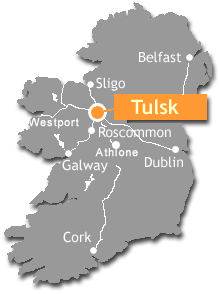
Rathcroghan Visitor Centre presents the third ‘Spiritual Capital of Connacht’ Conference Weekend, in Tulsk, Co. Roscommon, home of the Celtic Warrior Queen Medb (Maeve) and Battle Goddess, the Mórrigan.  Our theme this year is theGoddess Gathering, and we are inviting all who love the rich history, mythology, and culture of the strong Irish Goddess (and Irish women!) to come home, and join our Goddess Gathering spiritual conference in Roscommon 2013.

The weekend programme covers a wide range of interests - from the academic to the feminist to new age and celtic spirituality - and we actively encourage cross discipline discussion and learning throughout the event.

Our presenters and attendees are travelling from Ireland, and all over the world, to learn the Irish names, enjoy Irish food, and make friends with like minded people.  This event is a celebration of Irish culture and heritage, as well as an exploration of Goddess culture and studies in Ireland, and is fast becoming one of the most interesting things to do in Ireland.

If you're planning a trip this year, but don't know yet what to do in Ireland, this event in Rathcroghan, Ireland's Spiritual Heartland, is one of the most interesting things to do, and unique places to visit, that you can choose.

View the Programme and Speaker Info Here!

Book Your Place Now on www.irishgoddess.com/book-your-place.html

Thursday, May 9, 2013

November 2013 Events in Roscommon

Friday 1st to Sunday 3rd November 2013Roscommon Writing Festival is on  in Strokestown. This is a weekend celebration of Irish Writing:  Practical Workshops, Historical Literature, Talks, Book Signings, a Book Fair, and Creativite Inspiration. Do you want to get published, or finish your own book this year?

Wednesday 20th to 24th November, the Boyle Musical Society Annual Show is on in St. Joseph's Hall, Boyle, where the musical society will stage their 30th musical production.

Goddess Gathering Ireland 2013

Friday 22nd, Saturday 23rd, and Sunday 24th November 2013, the Goddess Gathering Ireland is on in Tulsk, Co. Roscommon.  The ceremonial and spiritual capital of this region is Rathcroghan – this is the legendary Cruachan, home of Queen Maeve (Medb), palace and sacred centre for the Druids, Kings and Queens of Connacht all through the ages.

On the weekend of November 22nd to 24th, Irish Goddesses can come home for the Gathering Ireland 2013!  Rathcroghan Visitor Centre presents the third ‘Spiritual Capital of Connacht’ Conference Weekend. This special event theme is the Goddess Gathering, and we are inviting all who love the rich history, mythology, and culture of the strong Irish Goddess (and Irish women!) to come home, and join our Goddess Gathering spiritual conference in Roscommon 2013.  View the Website for further details and Booking.

28th November 2013, the Monthly Lecture Series continues at the Rathcroghan Visitor Centre, on the last Thursday of every Month, from 7 to 9pm.

Weekly Roscommon Farmers Market every Friday - Roscommon 10am to 2pm, and Strokestown 10am to 3pm, and every Saturday Boyle 10am to 2pm, and Ballaghaderreen 10am to 2pm.

Wednesday, January 30, 2013

Queen Medb of Roscommon


Queen Medb (the Old Irish spelling), or if you'd prefer... Middle Irish: Meḋḃ, Meaḋḃ; early modern Irish: Meadhbh; reformed modern Irish Méabh, Medbh; sometimes Anglicised Maeve, Maev or Maive (pronounced May-v).  Warrior Queen of Gaelic or 'Celtic' Connacht (Connaught), the western province of Ireland.  Her home is Rathcroghan, County Roscommon, the ancient Royal capital of Connacht.

Wait a minute - Roscommon?  Isn't Queen Maeve associated with County Sligo?
Perhaps she is, now, but her historical home, the palace of Queen Medb, is ancient Cruachan - which is Rathcroghan, in County Roscommon.  Seriously, you can look it up, it's all available through Google.
It was from Cruachan that she began the Táin Bó Cuailnge, the epic Cattle Raid of Cooley, and the Tain Trail runs cross country from Rathcroghan, County Roscommon, right over to Cooley, Co. Louth.  And back again.
Queen Maeve of Cruachan, Co. Roscommon
Queen Maedhbh of Cruachan, bearing the head of a bull.  Bronze statue seen in Beresford Place, Dublin, created by artist Patrick O'Reilly.
But she was buried in Sligo, right?  'Maeve's Grave' is up that mountain, with all the stones...?
Well, not exactly.  Maybe.  'Maeve's Cairn' in Co. Sligo, is the best known burial site of Queen Maeve, but it is one of three possible sites.  According to some legends, she is indeed buried in the 40ft (12m) high stone cairn on the summit of Knocknarea (Cnoc na Rí in Irish, Hill of the King/Queen) in County Sligo.  The story goes that she is buried upright, facing her enemies in Ulster.

In Bronze or Iron Age burials though, it would be common enough to hack an important dead person apart and bury bits of them along different boundaries, for protection and guardianship.  Another story goes that she is buried in the hill of Knockma (Cnoc Medb in Irish, Hill of Maeve), near Belclare in Co. Galway, which is also where Fionnbharr, King of the Connacht Sidhe, holds court.  The Fairy connection is an interesting one, and maybe related to her later associations with Mab, the Fairy Queen?  The boundary theory holds here too though, as the views from the top of Knockma are spectacular.  Very convenient for a guardianship position, we'd say.

Her home in Cruachan, at Rathcroghan, Co. Roscommon is the third (and most likely) burial site, with a long low slab named Misgaun Medb being given as the probable location.  In the 'she got chopped up in bitty bits and buried' theory, this is where her soul (most likely to be contained in her head, according to thinking of the time) would be.  Or possibly her heart.  Whatever was deemed the most important part would have stayed at home, with other bits spreading out at lesser sites along the boundaries.

You can find out more on a dedicated website at:  www.QueenMaeve.org
There's also a Facebook Page and you can even follow Queen Meave on Twitter!

Tuesday, November 22, 2011

Spiritual Conference 2011 in Tulsk


THIS POST IS FOR THE 2011 EVENT!

For Information on the Goddess Gathering 2013, with special guest speakers Dr. Vivianne Crowley, and Janet Farrar, please visit us at www.IrishGoddess.com 
and register your interest through the online form!


Spiritual Capital of Connacht Conference Weekend, Tulsk, Co Roscommon

Event theme is “Connecting with the Land”, and we are delighted to announce our new spiritual conference event in Roscommon:

Since before history the West & Northwest of Ireland has been a place with a spiritual resonance. A place where Christian scholars kept civilisation alive. A place where belief and landscape merge. A place where you can feel things you can’t touch, where you experience an authentic unspoilt nature and timeless faith. A place where you can open your heart and lift your spirits – Ireland’s Spiritual Heartland.

The ceremonial and spiritual capital of this region is Rathcroghan, in County Roscommon – this is the legendary Cruachan, palace and sacred centre for the Druids, Kings and Queens of Connacht all through the ages.

Saturday 26th and Sunday 27th November 2011

€20 for Weekend Ticket!
€15 value Day Pass for Saturday talks, Individual Price = €5 per talk
(Saturday Pre-Booked Day Pass only €12!)


« Deirdre Wadding of Tall Tales Troubadors

Song of the Land. Every place has its own sound and song; listening for it and singing it back to the land forges a connection. Exploring the ‘Song of Amairgin’ from Irish legend, the use of our native language in magical work, and how the land responds!

« Lora O’Brien, Irish Author and Bean Draoí

Goddesses of Connacht: From Medb to the Morrigan, we all know the usual suspects. But what of Flidhais, she of Castlerea sovereignty? What of Gaillimh inion Breasail, and does her aspect have an effect on the many Brazilians who are drawn to the West of Ireland?! And even Mongfind and Cairenn, ancient rivals who between them birthed the Connachta and the Uí Niall clans? Recommended for those who want to explore their feminine side; will include journeying and self development work, along with a healthy dose of Irish heritage information.

« John Sinnott, B.A. Arch, of Irish Heritage Crafts

Sacred Sites: Care and Responsibility. A qualified Archaeologist, Alexandrian 1* and member of Cois Teallaigh Coven in County Roscommon, John has extensive experience working with sacred sites, through both the archaeological and pagan fields. This talk was designed to show that many practices which are viewed as quite standard among pagans, could actually damage the sites we profess to care for.

« Francis De’Venney, of Faol Lia Historical Re-enactment Society

Land and Ancestors. A fascinating insight into the ancient Irish psyche, from an anthropologist and accomplished practitioner of 30+ years experience

« Talas Pái of Roscommon’s Huginn Press

Working With the Wights. The numinous is all around us, from temples and trees to your house and car. In this talk, Talas takes an animistic approach to working with the wights, sidhe, vaettir and other spirits. The talk ranges from theoretical to practical — what the wights are and where they fit into the cosmos to how, where and why to approach and work with them.

« Con Connor of Roscommon’s Druid School

Eachtra, a Celtic dreaming, guided visualisation journey with the Cauldron of Vocation and the Realm of Land. Eachtra is the White Mare as the Celtic Goddess and we journey with her to meet the Ancestor Clan where we get an individual message as spiritual guidance.

« Del Eagle, (Sunday Morning, 2 Talks)

Flower Essences and how they are made, the connection between Earth and Sky

Tantra, the connection between Earth/Body and Spirit

SUNDAY AFTERNOON - 2pm to 5pm
Appointments available with Readers (Tarot, etc) and Healers, therapists.
(Individual Booking Costs will apply!)


Spiritual Capital of Connacht
Conference Weekend, Tulsk, Co Roscommon
Saturday 26th November 2011
TIME
SPEAKER
TOPIC
10am – 10.45am
Deirdre Wadding
Song of the Land
11am – 11.45am
Lora O’Brien
Goddesses of Connacht
12noon – 12.45pm
John Sinnott
Sacred Sites: Care and Responsibility
1pm-2pm
Lunch
Shopping
2pm-2.45pm
Talas Pái
Working with the Wights/Spirits
3pm – 3.45pm
Fran De’Venney
Land and Ancestors
4pm – 5pm
Con Connor
Eachtra, a Celtic dreaming
Individual price - €5 per talk/workshop
Value Day Ticket – just €15!

Spiritual Capital of Connacht
Conference Weekend, Tulsk, Co Roscommon
Sunday 27th November 2011
TIME
SPEAKER
TOPIC
11am – 11.45am
Del Eagle
Tantra Connection
12noon – 12.45am
Del Eagle
Bach Flower Essences
Individual price - €5 per talk/workshop
Value Weekend Ticket – just €20!
(all talks & workshops, Saturday & Sunday)
Sunday Afternoon from 2pm to 5pm
Appointments Available
with Healers and Readers
Individual Booking Costs will apply!
Booking on 071 9639268